


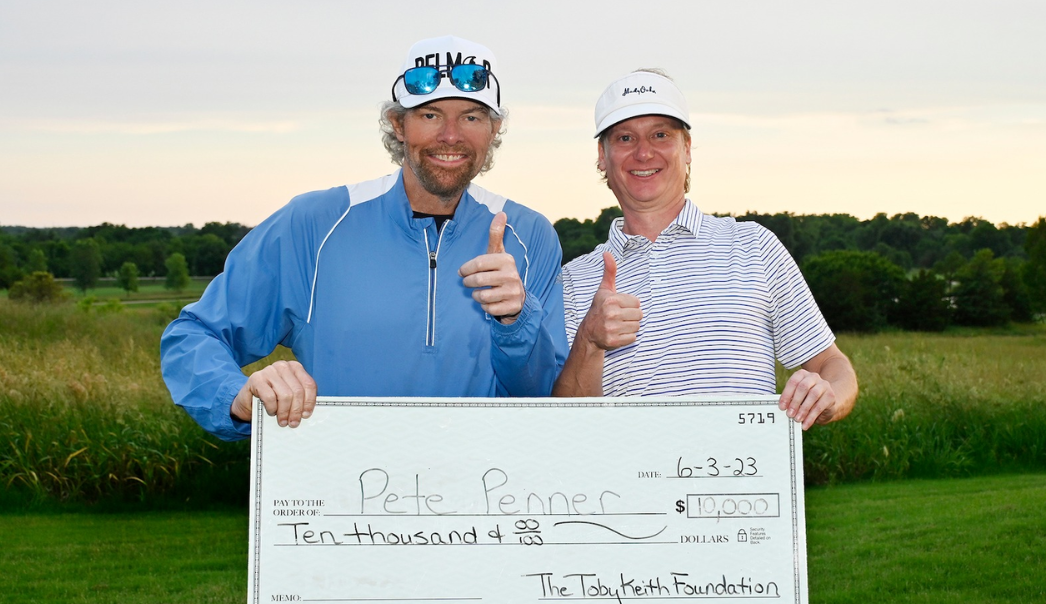
February 5 marks a deeply somber day in country music as fans remember the loss of legend Toby Keith, who passed away two years ago on this date. Beyond leaving behind a legacy that spanned more than 30 monumental years in the industry, an affinity for red Solo cups and 32 Billboard Number 1 hits, the “Should’ve Been a Cowboy” singer was also an incredible philanthropist.
At just 62 years old, the renaissance man of country music, whose resume included roles as a singer-songwriter, producer, actor, and businessman, sadly lost his battle with stomach cancer. His passing not only devastated fans worldwide but also brought attention to a less common form of cancer in the United States.
Long before Keith’s diagnosis, the Toby Keith Foundation was created in 2006 to help children battling cancer. This mission led to the opening of OK Kids Korral in 2014, a “cost-free, convenient and comfortable home for pediatric cancer patients receiving treatment at The Children’s Hospital at OU Medical Center, Stephenson Cancer Center and other nearby facilities.”
Keith’s dedication to pediatric cancer outreach began after the heartbreaking death of his guitar player’s two-year-old daughter from Wilms cancer. Following her passing, Keith began donating to St. Jude Children’s Research Hospital and was inspired by its all-encompassing giving spirit. This ultimately motivated him to build a similar support facility in his hometown of Oklahoma City, ensuring families could focus on healing without the burden of travel and lodging costs.
In an interview following his death, longtime friend and “Time Flies” duet partner, Colt Ford, sat down with the Ten Year Town podcast to talk about his fondest memories with the legend. Host and singer-songwriter, Troy Cartwright, posed the question, “What’s something about Toby that you wish people knew that don’t know him?”
Ford responded, “Toby’s OK Korral in Oklahoma City is like 20-30 private rooms, that’s exactly like St. Jude’s, that he puts about twenty million dollars out of his pocket to run. There’s a lot of guys doing stuff, you ain’t doin that.”
He goes on to describe how astonishing this level of generosity truly is, “But like out of his pocket. I know people go out and raise money, but they aren’t stroking a twenty-million check out of your pocket. First of all, very few can stroke that check, but second of all, as I went with him one day. I mean, I’m talking about there’s kids in quarantine, I mean like these parents pay for nothing. It is like the Ritz-Carlton. Everythings provided for 24 hours a day. He paid for all this sh** himself, man, like that’s crazy.”
Heartbreakingly in one of his last public interviews with News 9, just months before his death, Keith revealed one of his biggest fears before dying, “What’s amazing is the first thing I thought of when I got cancer was who’s going to take care of the Korral really who’s going to fund the Korral who’s going to raise the money who will carry that torch? It was one of the first thoughts I had.”
He goes on to explain the long-winded process that went into kickstarting the OK Korral, including a ten-year period to get the money fundraised and around eight years to acquire the property across from the nearby hospital, which then led to another ten years of building the finely orchestrated construction of it all and resourcing the best oncologists and doctors.
Fortunately, despite his fears, Keith’s legacy has continued to thrive. The foundation and private care programs he helped establish remain strong and active today. In honor of his name and ongoing mission, two major fundraising events now lead much of the organization’s outreach: the Toby Keith & Friends Golf Classic, taking place June 12–13, and the 5th Annual Invitational Clay Shoot, scheduled for later this year on Friday, October 2. Last year’s 2025 Golf Classic raised a record-breaking $1.4 million, and with this year’s tournament featuring bids on various concert tickets and autographed items from Taylor Swift, Post Malone, Roger Clemens, and more, there’s a strong chance it will surpass that total.
In Colt Ford’s interview, he closes with a moving story from a visit he once made to the facility with Keith, saying, “We were walking out and uh this guy came running out of the place, we were leaving, we’re getting in the truck. ‘Mr Keith! Mr Keith!’ You look at this guy, and you go, ‘tough life. hard life.’ Like oil rig, not money, and this dude just broke down crying, like if it wasn’t for you, my son…”
Choked up, he continues, “and then at that moment you’re like, wow, that’s this is a big deal. And for a guy like that to just be that emotional and to another man and be that humble. I’d like to be able to do something like that.”
That image alone is enough to bring tears to anyone’s eyes, and as Ford points out, it lights a fire to want to give back. Carrying on Keith’s legacy, many country artists have since visited the facility to share the gift of music with patients, including Zach Top last October, Dylan Gossett this past March, Jelly Roll, and more.
In the spirit of recognizing his death, not only is it mandatory to drink at least one beverage out of a red solo cup today, but also consider donating to help keep Keith’s wish alive at continuetogive.com.